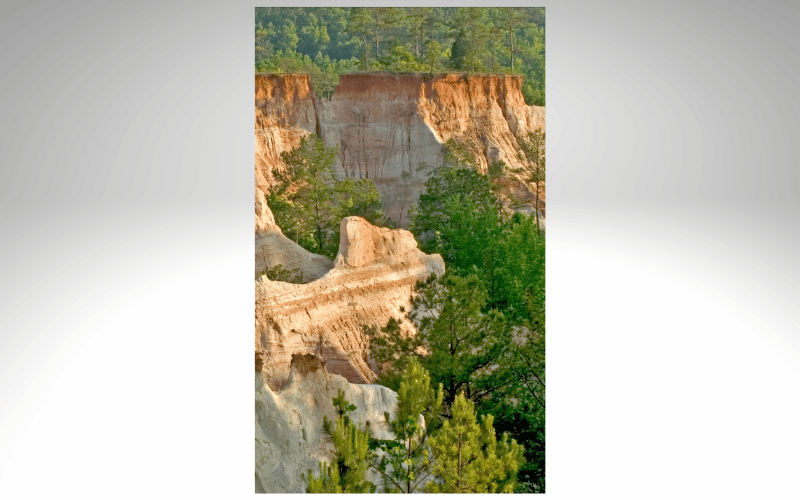
The Providence Canyon is a result of unwise farming techniques in the 1800s that led to the formation of huge erosion gulleys, which are amazing today at 150 feet deep. The gulleys formed when the farming techniques allowed water to flow unimpeded down the slopes.
The water gradually cut through the erosion-resistant upper layer, exposing the colorful sandy soil named by geologists as “the Providence formation,” noted for its susceptibility to erosion. These formations were known as caves and in a short time grew in size and depth.
Geologists believe the canyons will continue to grow at a slower rate, as sides of the canyon continue to wash downstream.
Unique geological formations carved over time can be viewed in 43 shades of soil in the towering cliffs and gulleys, ranging from light orange to salmon to various shades of red and scarlet, complemented by whites, purples and pinks.
Views of the canyon can be enjoyed from the rim trail, behind fences and away from the fragile canyon edge. During July and August, visitors can also see the rare Plumleaf Azalea blooming that only grows in this region.
Guests of the park should first stop at the Visitors Center, located at the end of the parking lot. At the center, current information about aspects of the park is available. The center has restrooms, snacks and a gift shop.
A museum at the center provides the history and science behind the canyons. An Interpretive Center features exhibits and an audiovisual presentation on the canyon.
At the center, hikers can access maps and exhibits. Visitors should have plenty of water and sunscreen to take while hiking.
A variety of scenic hiking trails showcases the canyon’s views and brilliant soil formations. Trails for exploring the Little Grand Canyon’s nine dramatic canyons begin and end at the visitor’s center.
A favorite hike for visitors is the Canyon Loop Trail that is easily accessible and offers an immersive hiking experience. The easy to moderate 2.5-mile trail loops around the nine canyons that hikers are allowed to explore. The canyons display brilliantly colored walls.
Hikers who explore the deepest canyons will usually find a thin layer of water along the trail. Hiking the loop can take hours if time is spent in each canyon, and most will stop to take stunning photos.
Visitors should remember that while the canyon is striking, it is actively eroding and fragile. Hikers can lightly touch the walls, but any climbing, digging or carving into the walls is dangerous and strictly prohibited. Park rangers patrol the canyon floors and will write tickets.
After exploring all nine inner canyons, hikers can return to the visitor center or follow the Canyon Loop Trail to the other side of the canyon. Hiking up the other side takes visitors through overlooks with sweeping views of the canyon.
For a more challenging adventure, visitors can hike the Backcountry Trail, offering a rugged seven-mile loop through wooden terrain with steep grades. As the trail winds through the forest, it leads to old logging roads going past primitive campsites.
Those visiting the park for the day will want to pack a picnic. Some of the most scenic views can be seen at the park’s picnic area, which offers 65 tables and two picnic shelters with a grill. A stove and refrigerator are available nearby at Pioneer Shelter Three.
Reservations are needed for the picnic shelters, and there is a $35 fee for the day. Pioneer Shelter Three can be accessed for overnight use and is available for $85 per night. To reserve, call the Visitor Center at 229.838.6202 or book at GaStateParks.org.
Providence Canyon has six backcountry campsites for spending the night under the stars. Located two or three miles from the parking lot, the sites are primitive, and hikers will need to carry their own water, food and toiletry items in their backpacks.
Those who would like to stay overnight must arrive before the gate closes and before dark.
For larger groups such as scouts or clubs, the park has pioneer campsites for up to 30 people. These are located a quarter of a mile from the parking lot and are more spacious than the Backcountry Trail campsites.
For those who prefer comfortable accommodations, just nine miles away, the Florence Marina State Park offers modern camping, fully equipped cottages, and small efficiency units on the 45,000-acre Lake Walter F. George, which is also called Lake Eufaula.
A popular park for those who have a love of water sports, the lake offers an accessible fishing pier, boat slip and boat ramp. The park is a haven for herons and egrets and, occasionally, bald eagles.
The Florence Marina State Park was once home to Native Americans and the old town of Florence. Visitors can explore the Kirbo Interpretive Center that displays area wildlife, local history and Native American artifacts.
While the Providence Canyon State Park provides an interesting day trip, combining the trip with the nearby Florence Marina State Park creates a perfect weekend away for those who enjoy the outdoors.
Providence Canyon State Park is located west of Lumpkin, Ga., on Hwy. 39C. For further information go to GaStateParks.org/ProvidenceCanyon. For information on accommodations, including camping, cottages and efficiency units on the 45,000-acre Lake Walter F. George (Lake Eufaula), go GaStateParks.org/FlorenceMarina.