
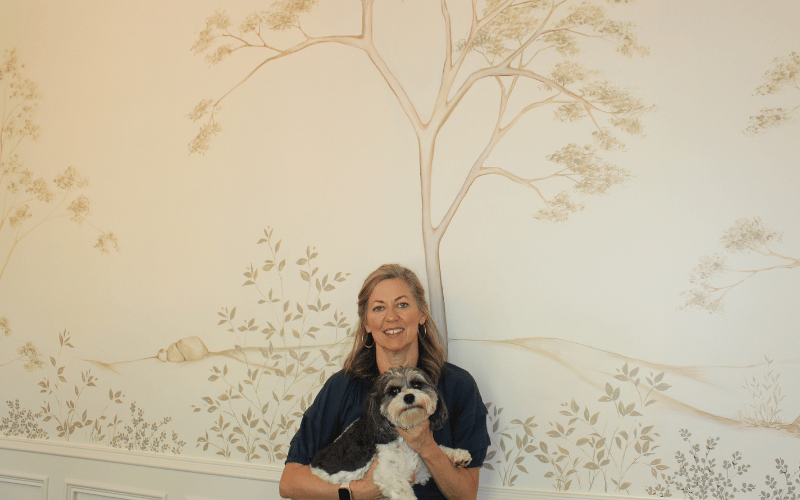
Inspired by the colors in nature, Mary Grace Heston of Auburn creates watercolor, acrylic and collage art in botanicals, torn paper, landscapes and Ebenezer stones*. The busy mother, who homeschools her youngest children, finds creating art calming and therapeutic. While her botanicals reflect detailed beauty in nature, Mary Grace’s painted stones in different shapes are an expression of God’s plan, fitting our lives together like a puzzle.
While growing up in Savannah, Ga., Mary Grace enjoyed working with her hands making crafts, coloring, drawing and completing paint-by-number kits. She took private art lessons and attended art camps. Her grandmother was an artist and inspired her.
In high school, Mary Grace took every art class available and won awards at several competitions. Although she received a scholarship to the Savannah College of Art and Design, Mary Grace turned it down to attend the University of Georgia, receiving a Bachelor of Fine Arts in drawing and painting. While she did sculpture and other art forms, the watercolor class was her favorite and remained her preferred style for painting.
After Mary Grace and her husband, Greg, married, they lived in Atlanta, Ga., and she taught art in public school until they began having children. Their family quickly grew with four children and adopting three children from China. When the children were small, she didn’t have time to paint. During summer, they attended family camp in North Carolina, and while the children were busy with activities, Mary Grace would enjoy basketmaking, bookmaking and painting watercolors on cards.
During those years, she taught homeschool art classes in her studio at home.
Three of their children are now married, and the Hestons have three grandchildren. As Greg, an Auburn University graduate, was preparing to retire from a 38-year career in public accounting, he had the opportunity to teach accounting at the university.
“As native Georgians,” says Mary Grace, “it was a big step to move to Auburn, but living here has exceeded my expectations.”
Her home studio in Auburn has numerous windows with sunlight dappling into the large space.
“When working on my paintings in my studio and looking out at God’s beauty all around me,” she says, “it calms my soul and restores my spirit. It is therapy for my type A personality.”
Having a love of nature and details, Mary Grace’s favorite things to paint are botanicals, landscapes, torn paper and Ebenezer stones. When she paints, she listens to audio books, podcasts and sermons.
While she has painted colorful botanicals in watercolors, currently Mary Grace is challenging herself by limiting her palette to just one color.
“I am attempting to capture the unique details of specific plants and flowers in a very realistic manner,” she says.
Her favorite watercolor artist is Winslow Homer. This past summer, the family visited Maine, and her husband planned a day trip that was coordinated through a museum to visit his studio.
“It was fabulous,” Mary Grace recalls. “I took lots of pictures on our trip and have many ideas for future projects stirring around in my brain.”
Another of her watercolor endeavors is “torn paper” that is influenced by Mark Rothko and Jules Olitski.
“I am always attracted to the simple edge of a torn piece of paper and the way the color bleeds into and dries there. These pieces are a bit moody and are all about creating an environment of depth, color and tiny changes made by the layering and use of different types of paper, especially rice paper, creating a calm quiet.”
Her third strand of art is watercolor landscapes.
“I struggle with being too detailed,” she says, “and it is a terrible thing to seek perfection. These are almost like exercises for me to let go and enjoy the watercolor doing its ‘thing.’”
Ebenezer stones are Mary Grace’s fourth favorite to paint.
“I love puzzles, details and the way rocks fit together just as our lives seem so chaotic at times,” she says. “Yet I believe that God is always in control. If we can pause in the moment of anxiety or worry and keep our brains where our feet are planted, hopefully we will be able to look back and see how God was working out the details.
“Each trial was for our good, planned and a perfect fit, the hard and good, drawing us closer to Him. In hindsight we see how it all fits together like a puzzle. In the beginning it is chaos and a mess.
“My stones have translated over into my botanicals,” she adds. “I have begun doing some larger flower paintings that are still based on lots of pieces making up the whole. These are more like puzzles, fitting the objects into their backgrounds, bringing order out of chaos.”
While her art is available in a variety of sizes, she also enjoys painting small botanicals, fruit and landscapes on cards. The cards are attractively framed to place on a desk, bookcase or on a stack of books. Her cards are not reproductions, and each one is an original watercolor.
Mary Grace also paints murals. During snow days last year, she completed a mural on her dining room walls in three days. She combined the style she was painting using one color for watercolor botanicals on the vertical wall.
“Another endeavor I enjoy is drying leaves, pressing them, painting them gold, and framing them,” she adds. “I love to always bring a bit of the outside inside, and this correlates with my love of planting and growing flowers.”
Mary Grace’s art is on display at Spotlight on Art at Trinity School in Atlanta, at Marguerites in Brookhaven in Atlanta and Blossom & Vine at John’s Creek, Atlanta, J. Pittman Interiors in Auburn, and Angels Antiques in Opelika. She has an upcoming show at the Wesleyan Artist Market.
“I hope that my art reflects my thankfulness and gratitude,” says Mary Grace. “I had no idea that I would get to do this and have the time to paint. It makes me happy, and it is fun to share my art. We are surrounded by beauty.
“I would not be where I am without the support of my husband, the encouragement of family and friends, and the fellow artists who have helped me navigate the world of Instagram and artists’ markets. It has been fun, and I am grateful.”
*Ebenezer stones are physical monuments of remembrance mentioned in the Bible, taking their name from the Hebrew word Ebenezer, which translates to “stone of help”. They were set up by ancient leaders as lasting, tangible reminders of God’s deliverance, provision, and faithfulness in times of trouble.

