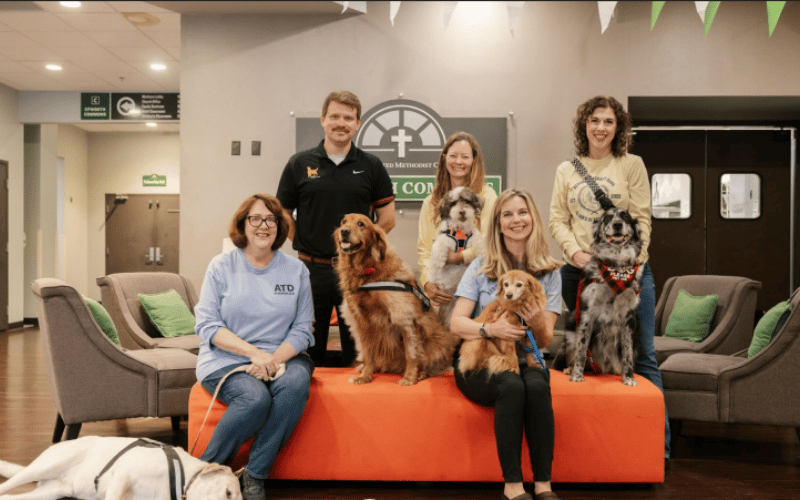
Will Leveille has had a fondness for dogs since childhood and a desire to share their unconditional love with others as therapy dogs. After having his golden retriever, CJ, certified, Will began visiting hospitals, nursing homes and other areas to offer a bright moment to all ages undergoing difficult times. When he recognized a larger need for animal-assisted therapy in East Alabama, Will organized the Auburn Therapy Dogs, which now has 30 teams and became a certified non-profit last May.
Will was raised in Middle, Ga., with two golden retrievers and developed a love of dogs. When he was in college, his parents’ dog, Ripken, was a sweet golden that wanted to be close to people.
“We always thought it would be great to share Ripken’s loving and comforting nature with others,” he says. “They took him to the Alliance of Therapy Dogs (ATD) to be tested. Ripken’s brother, Yogi, was also certified as a therapy dog, and they started doing visits together with my parents.”
The ATD is an international organization that provides testing, certification and insurance for members who volunteer their dogs for this line of work. They set a standard and test any breed for the right temperament for being therapy dogs. There are approximately 18,000 teams in the country.
Will attended the aviation program at Auburn University, and after graduating he lived in Atlanta for a year. He moved back to Auburn in 2018 to become a corporate pilot for Auburn University and now flies for a large corporation based in Atlanta.
During Covid when flying slowed down, Will was ready for a dog of his own. He saw CJ, a golden retriever, the day after she was born. He named her after the corporate jets at Auburn.
“From the moment I picked her up,” he says, “I knew that I wanted to do animal-assisted therapy work with her.”
All the therapy dogs must be at least a year old to go through the certification process, and CJ was certified on her first birthday.
“My goal was to start taking CJ to hospitals, the cancer center, nursing homes and other places to share comfort,” he adds. “When I started researching it, there wasn’t any organization doing dog therapy work in East Alabama. We did a lot of visits by ourselves.”
The ATD has a policy that after six months of serving as a therapy dog team, the dog’s handler can apply to become an evaluator. After six months, Will did the extra testing, became an evaluator and started certifying other teams in the area.
“With therapy dogs,” he says, “the goal is to socialize and desensitize them for when we take them into a medical facility, special needs program or on a disaster response. We need to know they are going to behave and not be upset by new smells, noises or sounds.”
Will has certified more than 60 teams for the Alliance with 30 of those serving as the Auburn Therapy Dogs. The dogs are different breeds and ages, and they all get along well.
“I never intended it to be a non-profit organization,” he says, “but many places in the community need us.”
The rule of thumb he uses in testing is the American Kennel Club’s 10-skill test for Canine Good Citizen.
“The things I check include seeing if the dog can behave in a unique environment, the dog can get along with other dogs and if the handler is proactive. I will pull on their hair and ear. I once saw a child stomp on CJ’s tail, but it didn’t phase her. That is the reaction we want.”
Among the places the therapy dogs visit is REACH (Refresh, Encourage, Activities, Care, Hope), a community respite ministry in Auburn. The program allows a respite for caretakers of those with mild to moderate dementia and their care partners. Therapy dog teams serve as greeters when the participants arrive.
The Auburn Therapy Dogs is the exclusive dog therapy group for East Alabama Health facilities, serving under Chaplain Laura Eason’s department.
“Because of their partnership with East Alabama Healthy and their training protocols,” says the chaplain, “Auburn Therapy Dog teams can go into the hospital at any time to serve the patients and staff.”
“When we go to the hospital,” says Will, “we are not talking to patients about health conditions. We talk about the dogs and their dogs. Our goal is to take their minds off their struggles.
“I encourage our teams to go to the hospital at least two times a week to visit with patients and staff,” he adds. “The owners and dogs have badges. We visit with the night shift too.”
The teams also visit the freestanding emergency room facility in Auburn, the Auburn Med Clinic, the Spencer Cancer Center and the new mental health facility.
During the Christmas season, about 80 percent of the teams dress up and go into the lobby of the hospital for the “rein dog parade.” They visit with patients and staff.
While their goal is to spread comfort and love with therapy dog teams, they are not limited to medical facilities and nursing homes. Sometimes they have requests for critical response, which included the shooting. For this tragedy, the teams visited the classmates of the students who were shot.
They also had requests for visits after the Tuskegee shooting and Beauregard tornado, as well as suicide response. They also visit the police and fire stations.
Will and CJ visited victims after the flooding in North Carolina.
“CJ was comfortable,” Will says, “because she has been well desensitized and socialized. Visiting the devastation was just another visit to her for an opportunity to spread her love and joy.”
The teams will visit any place where people could be stressed, upset, anxious or nervous.
“Their demeanor changes when they see the dogs,” he says. “At the Spencer Cancer Center, none of our dogs fix what cancer takes away, but for a few minutes, they give something back. In a place filled with hard news and a struggle for life, the dogs bring a little normalcy, comfort and hope. It is beautiful to see.”
Will remembers one visit at the hospital late at night, walking down the corridors with CJ’s tags clinking.
“A nurse asked if CJ was a therapy dog, then got on her knees to hug her and began crying. CJ took her hand. She said she had an awful day and needed it. We visit with the staff as well as the patients. That is why we are there.”
In May 2025, the Auburn Therapy Dogs became an official certified 501(c) (3) non-profit organization.
“All of our dogs are currently certified through the Alliance of Therapy Dogs,” says Will. “They are covered under their insurance as well as the people we visit. The goal is for the Auburn Therapy Dogs to eventually stand on their own and to provide our own insurance. We need donations and support from the community we serve.
“Each of our teams are giving their time and sharing the love of their dog with someone else. Some like to visit different locations, while others are more comfortable visiting the same ones. It takes all of us working as one organization to meet the ever-growing need for animal-assisted therapy in our community. The impact it has had on the people we visit has truly astonished me.
“The hardest part is getting the word out for awareness and fundraising,” he adds. “People can reach out on social media and Instagram to schedule a visit, make a donation or to become involved.
“I am incredibly blessed,” Will says. “I want people to know that the Auburn Therapy Dogs organization is a resource to the community. We make every effort to visit with all those who need us in the community. It is a beautiful ministry sharing our dogs’ love with others, and even more beautiful seeing the impact they have on those going through difficult times.”