
By Ann Cipperly
Native America art brings the spirit of the West to Opelika’s Northside Historic District
Baskets, rugs, pottery and other Southwestern cultural arts collected from the Navajo Nation and Hopi mesas create a stunning blend of Southwestern art with Southern antiques at the home of Penney and John Varner in the Opelika Northside Historic District. The unexpected decor in their historic home reflects years living and traveling in the West before moving to Opelika from Wyoming in November 2019.
The Varners were familiar with the area since John grew up in Tuskegee and graduated from Auburn University. The couple knew they wanted to move here after retiring to be near John’s mother who lives in Auburn, and help manage Varner family properties in Macon County, where his grandfather had been a well-known probate judge.
John was a forester on the Rio Grande National Forest when he met Penney, who is from Colorado Springs, and was attending Adams State College (now University) in Alamosa, Colo. When Penney and John married, they lived in Southern Colorado, just north of Taos, N.M.
Life took an interesting turn in 1986 when John was transferred to the Medicine Bow National Forest, and the couple made Encampment, Wyo., population 450, their home for the next 33 years. John retired from a career in the US Forest Service and Penney from teaching public school.
They traveled often to the four corners area of New Mexico, Colorado, Utah and Arizona, appreciating and searching for arts and crafts the Native Americans were producing. “We started buying a few pieces and at some point, got carried away,” says John. Penney has documented where each item was acquired.
“It was fun,” adds Penney. “We went to pawn shops, auctions, galleries and purchased directly from tribal artists, and it became a treasure hunt. We were fascinated with the details of creating the art. We started buying from the artists directly because when sold to a trading post or somewhere else, they don’t receive the funds they deserve. They have put so much time into the art.”
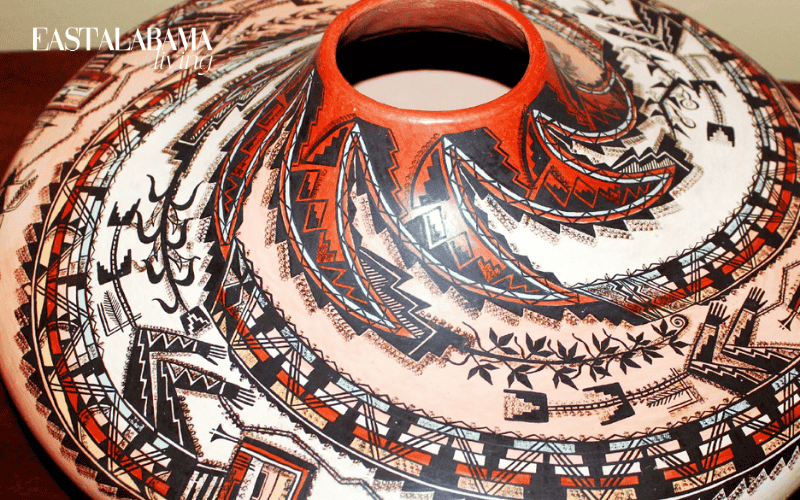
Most of their collections include pottery from the Pueblos in Northern New Mexico, rugs from the Navajo Nation in Northeast Arizona, and Hopi baskets and pottery from their Hopi Tribal Land, which is located in the middle of the Navajo Nation.
The highly polished black and red wares are from the Santa Clara and San Ildefonso Pueblos in Northern New Mexico. The traditional white clay pottery is from the Acoma Pueblo.
The Varners have about 60 handwoven baskets from the villages of the three Hopi mesas. They are made of yucca, a drought tolerant species with long, stiff sword shaped leaves. Every basket is different, and each pattern has meaning. The Hopi use the baskets for gifts and ceremonies.
They admire the colors and designs on the rugs and have an appreciation for the way they are created. On the Navajo rugs, the weavers prepare wool and dye it. Then it is placed on an upright loom.
“The process is incredible for how they produce the rugs,” says Penney. “It is so much work. We came to appreciate the rugs so much and love them in our home.”
The Varners looked for the perfect home for two years. The house they are in currently was for sale, but it needed too much work. Almost two years later, the house was back on the market after having been purchased and updated. They took a second look, thought it was ideal, and they didn’t have to do any renovation.
The historic house was built in the early 1900s with 12 foot ceilings. It was expanded in the 1950s and later restored by Lucinda Samford Cannon in the late 1980s. Lucinda added the wraparound front porch and expansion to the back of the house, including a deck.
“I always said if we moved to the South,” says Penney, “I wanted a house with a wraparound porch to hang the swing handmade by my great grandfather.”
Most of the rooms in their home are filled with Native American art, including baskets, pottery, rugs and other items mingled with antiques. The baskets and rugs fit perfectly in the historic home. They have two large rugs that they could not hang in their Wyoming house. Since this house has tall ceilings, they fit perfectly.
The high ceilings also provide space for their heirloom nine foot tall secretary desk from John’s grandfather’s house in Tuskegee.
“According to my dad,” says John, “the secretary was in the house when my grandparents purchased it.”
The desk displays Pueblo pottery, as well as pottery from Hopi.
In the living room, a collection of Hopi baskets is displayed across one wall near the ceiling. On the mantel, black on black pottery from the Pueblos are handsomely displayed, giving a stylish look.
While their home is filled with collections, the piano in the living room is one of Penney’s most treasured family items. Her family moved west from Chicago in the mid 1800s settling in Longmont, Colo. Her great grandmother had the piano sent to Denver on the train from Chicago. Then it was transferred by wagon to Longmont, where it stayed in the same house for more than 100 years. Penney inherited it and first moved it to Wyoming and then on to Alabama.
In the den to the right of the living room, a large collection of pottery and rugs is artfully arranged from a variety of places in the Southwest. Another interesting rug that is all natural dyes from plants and minerals is featured in one of the bedrooms.
Baskets are also featured in the spacious kitchen, and a Southwestern painting hangs above the fireplace. Penney’s great grandmother’s Sellers hutch in the kitchen is another treasured family piece. The hutch was popular from the late 19th century and stored kitchen equipment, dry goods and utensils.
Other family antiques are showcased in the dining room.
“My family’s antiques are more Pioneer style brought from Illinois to Longmont, Colo.,” says Penney, “while John’s family’s Southern antiques are grand and elegant.”
An antique table and buffet from John’s family and a china cabinet from Penney’s family highlight the dining room.
Both Penney and John have become involved in the community.
“Opelika has been delightful,” says Penney. “We are so pleased with the people, and there are so many things to do. When we lived in Wyoming all those years, we didn’t even have a grocery store, and medical care was 90 miles away.
“I am glad all of our art collections fit in this house, and we feel fortunate to live here. We have made so many friends, we love our neighbors, we love the town and everything about it. We feel blessed.”


